Your Job Will Evolve. The Data Says How.
AI is coming for your job, one hundred percent. Just not in the way most people fear.
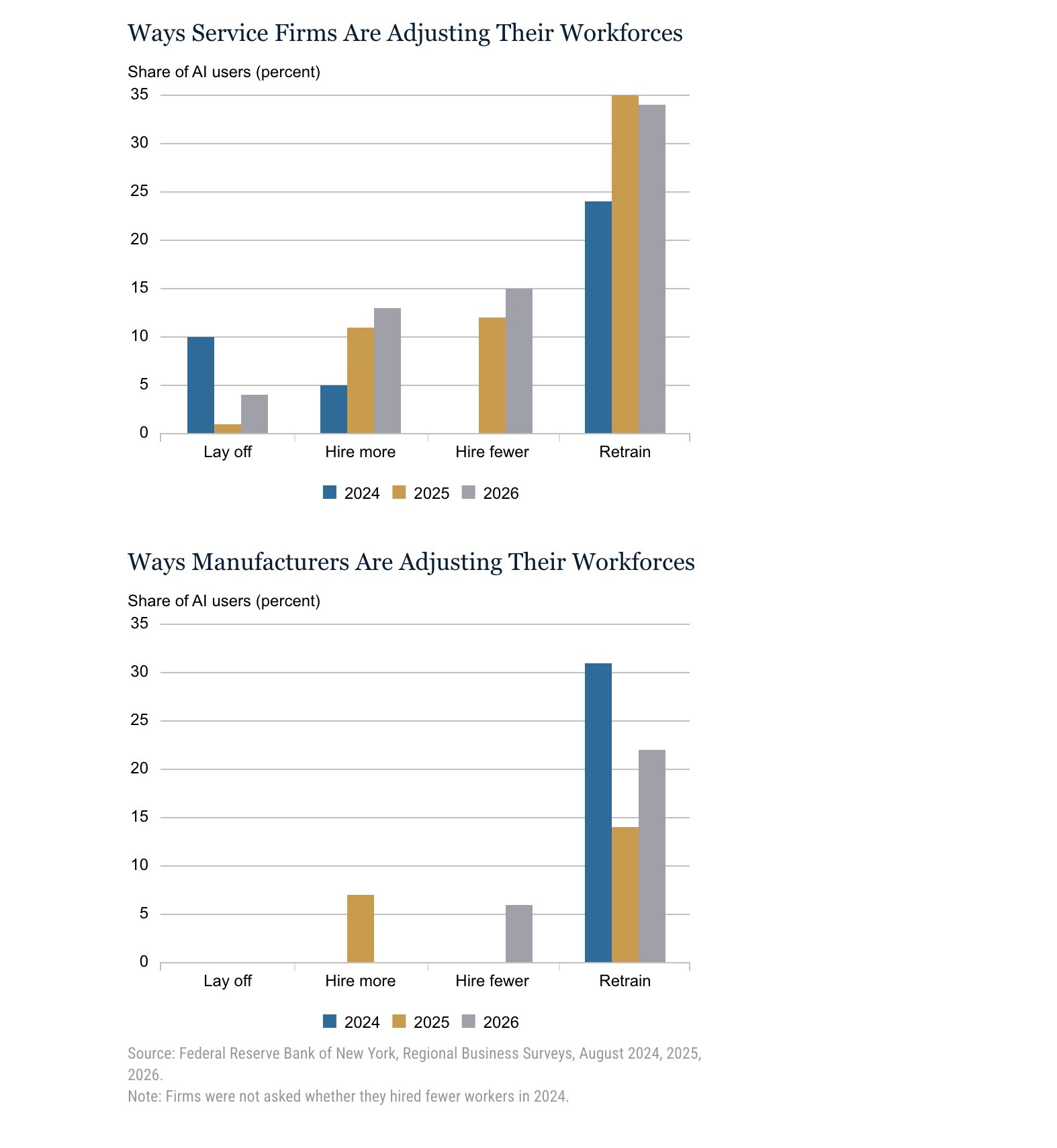
Coming out of Labor Day, I found a chart from the New York Fed more reassuring than I expected. In their latest regional business survey, retraining is the tallest bar for firms adjusting their workforce around AI. Layoffs barely register. Only 4 percent of service firms using AI reported laying anyone off because of it in the previous six months. None of the manufacturers did.
Your job will still change. AI is coming for the part that moves information from one place to another, turns it into the weekly report, and gets that report where it needs to go. The production-level work that eats a shocking amount of a knowledge worker’s week. I call that the $9-an-hour work. It needs to get done, but it doesn’t require your years of experience, judgment, taste, or empathy.
A company has a choice with the time that frees up. It can use AI to cut people and keep producing the same things at a better margin. Some will. Or it can retrain the people already closest to the work and the customer, give them room to apply the judgment that’s been buried under production, and use that capacity to improve what it does and chase new growth. The chart suggests many employers are at least leaning toward the second option. I find that reassuring. I don’t think it gives anyone permission to get complacent.
The objection that’s about to collapse
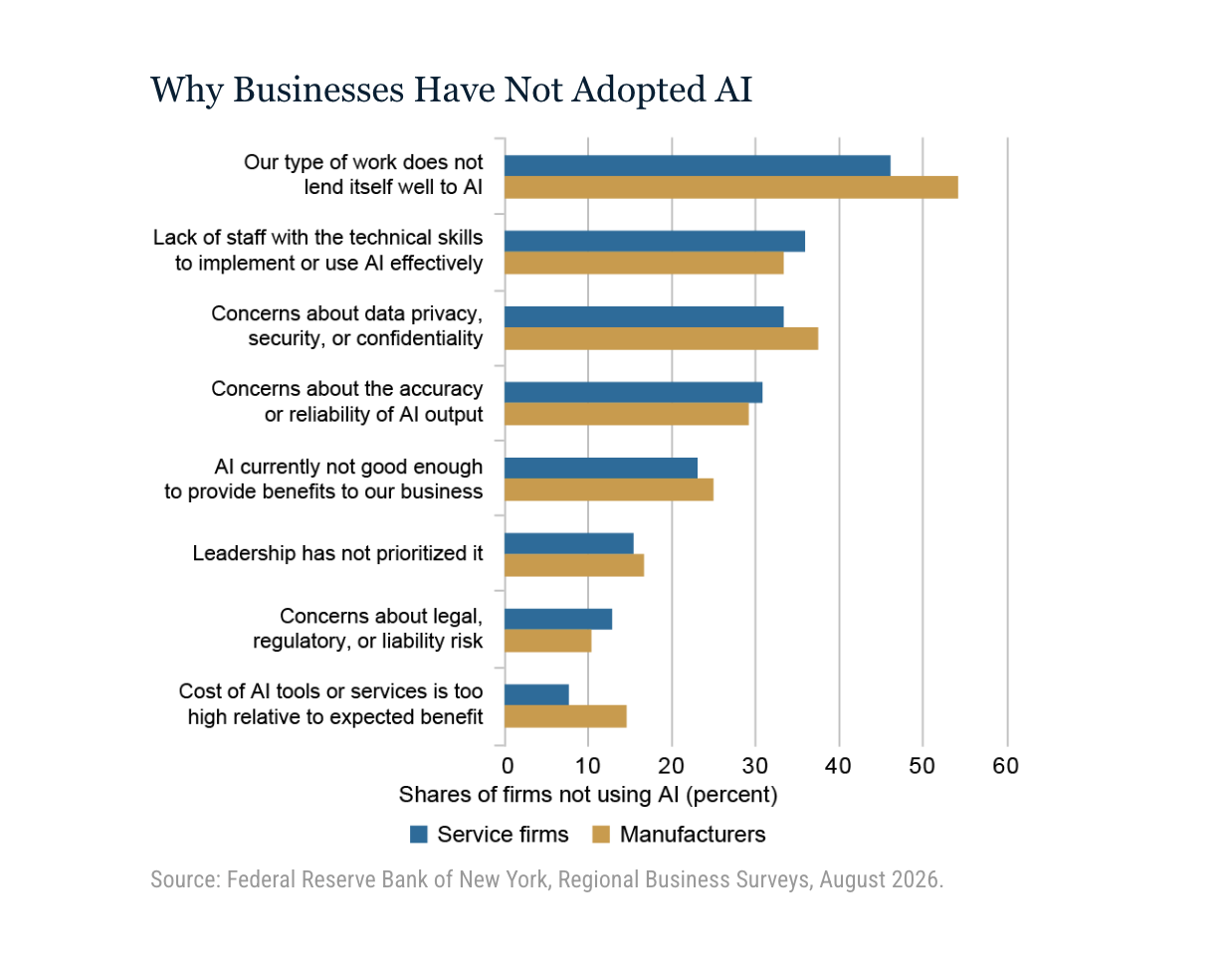
There’s a second chart in the same report, listing why businesses haven’t adopted AI. The top reason, for both service firms and manufacturers, is “our type of work does not lend itself well to AI.”
I understand why that feels true. A lot of companies still understand AI primarily through chatbots, coding, and content. If your business doesn’t fit one of those buckets, “our work doesn’t lend itself to AI” sounds reasonable.
That conclusion gets harder to defend when you pull the actual workflows apart. AI doesn’t have to perform your company’s core service to change how the company works. It may only need to compress ten hours of admin work into 45 minutes inside a process that runs every week. Start there. Where are your bottlenecks and cost overruns? Which part of the process takes far longer than it should? Find the friction first, then ask how AI can help.
By then, “our work does not lend itself to AI” may sound a lot more like “we never looked very closely.”
That’s the shift I’d bet on. When the normal question becomes “where are our bottlenecks and cost overruns, and how can AI help us solve them,” that top bar drops fast.
For you, the individual, the takeaway sits underneath all of it. This isn’t only a management story. At most levels, the job is going to evolve. Start handing AI the $9-an-hour work where you can. Use the time it gives back to get more reps on the judgment-heavy parts of your role. Then build something that makes that value visible. The job you came back to after Labor Day probably won’t exist in its current form forever. That may turn out to be good news.
Source: Federal Reserve Bank of New York, Regional Business Surveys, August 2026.